
Empowering Lean Manufacturers with Smarter Technologies
Eliminate search time, shorten lead-times, and expose flow interruptions with RTLS built for the shop floor – not IT.
- Spot WIP queues and bottlenecks in real time
- Cut motion and search waste for operators and leaders
- See standard vs. actual flow across every line and cell
Trusted by lean, multi-site manufacturers to keep flow visible from dock to dock.
Get your RTLS value map
Share a few details about your plant, and we’ll map where real-time location data can remove waste in your value streams.
Typical response time: under 1 business day. We never share your information.
Designed with operators, supervisors, and lean leaders on the shop floor.















Mission
In lean manufacturing lingo, "Gemba" is the shop floor, the place where the work happens, and the place where value is created (sometimes also referred to as the "place of truth"!). Gemba Systems' mission is to empower people on the shop floor with smarter technologies that support and enable better processes, resulting in higher productivity, better quality, and improved morale.
Our Offerings
Gemba Systems Inc. supports manufacturing companies in the digitalization of their operations, especially focused on improving their manufacturing execution systems. We help companies navigate the complex and fast-evolving landscape of “smart manufacturing” and the Industrial Internet of Things. We offer guidance, tools, and hands-on support in the selection and implementation of those Industry 4.0 technologies that will best support our clients' most critical business processes, and the people who perform them.
Aligning People, Processes, and Technology
In order to create more value, companies need to reduce waste, reduce variation, and improve their responsiveness and agility. To achieve this, they need well-trained people, performing well-defined and controlled processes, assisted by capable, fit-for-use, and reliable technology. We help companies achieve better performance by putting in place more effective production systems consisting of well-aligned people, processes, and technology.

Stijn Van de Velde
Chief Executive Officer

Joseph Etris
Vice President of IoT Solutions

Alain Decartes
Chief Operating Officer

Russ Daniel
Solutions Arthitect
See your flow like a value stream map that updates itself
Gemba Systems connects tags, assets, and WIP locations so your lean team can see true flow in real time – without walking the entire plant every hour.
- Expose hidden WIP and queue time instantly
- Alert leaders when takt is missed at any station
- Quantify motion and search waste with hard data
Outcome: faster problem solving at the gemba, less firefighting, and a flow picture leadership can act on daily.
Typical impact in 90 days
Based on results from mid-volume discrete manufacturers implementing RTLS with a single pilot area first.
From tags to actionable signals in weeks, not years
Gemba Systems is built for focused, high-ROI pilots that scale. We’ll meet you at your current lean maturity and IT constraints.
1. Align on value stream & problem
We start at the gemba with your team: current state map, constraints, and where you suspect flow is breaking (queues, changeovers, handoffs).
2. Deploy tags & location anchors
We instrument selected assets, WIP, or containers with tags; anchors read position data and stream it securely to Gemba Systems in real time.
3. Turn data into lean signals
Flow dashboards, queue alerts, standard vs. actual heatmaps, and reports shaped for daily tier meetings and leadership reviews.
Where lean teams start with RTLS
Focus on a single constraint or high-variance area first. Common starting points for Gemba Systems customers:
Final assembly & kitting
Track WIP carts and kits through each station. Spot where work piles up and how long it sits before assembly, test, or pack-out.
Internal logistics & supermarkets
Monitor tugger routes, milk runs, and material presentation so operators never wait for parts and supermarkets stay balanced.
High-value assets & tools
Know exactly where fixtures, gauges, and shared equipment are being used and where they wait idle between shifts or changeovers.
Measure what matters for flow, safety, and delivery
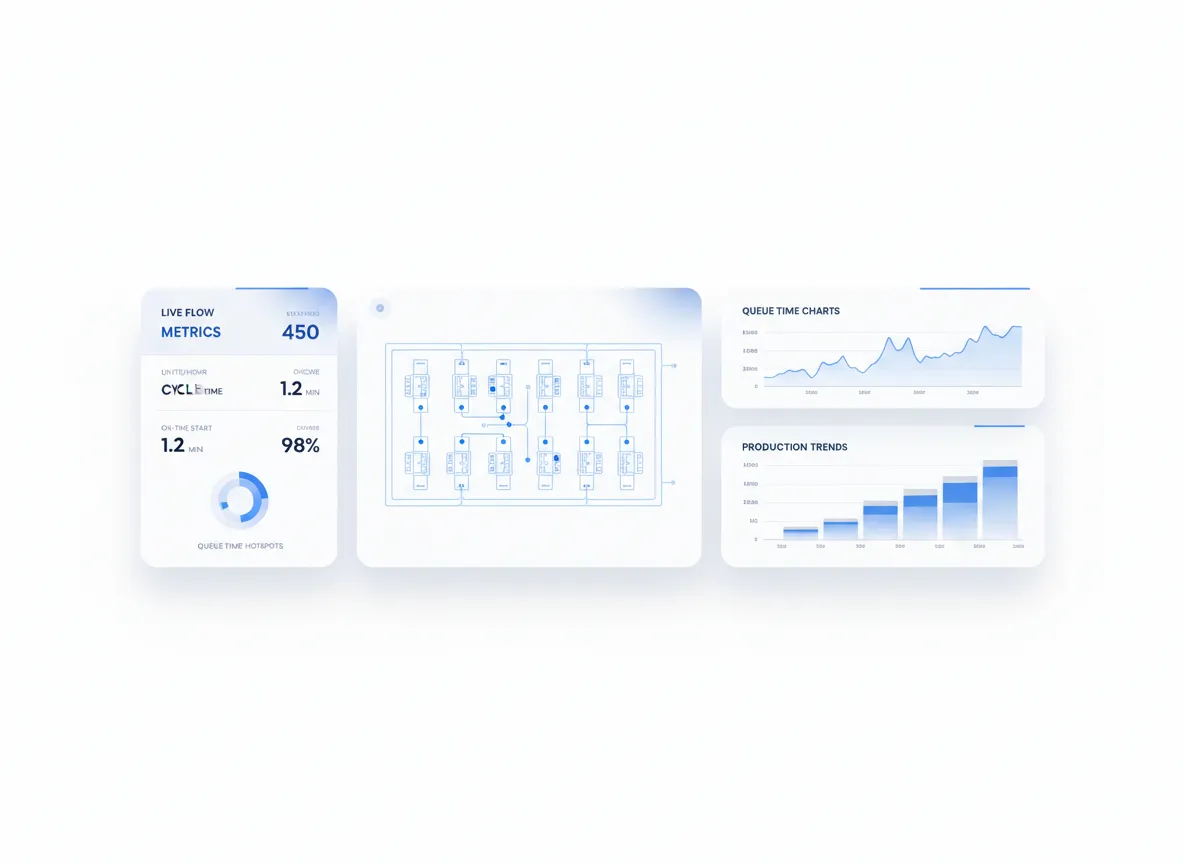
Instead of more static reports, Gemba Systems gives your team live, operational metrics that update every few seconds.
- Actual lead-time by product family and route
- Queue and dwell time at each key location
- On-time completion vs. plan by cell or line
- Heatmaps of congestion and blocked pathways
Use the data in daily tier meetings, kaizen events, and leadership reviews to prove impact and prioritize the next improvement.
See where RTLS pays back in your plant
In a 30-minute demo, we’ll map your current flow, highlight candidate pilot areas, and outline the data you’d see in the first 90 days.
We’ll follow up with 2–3 time options for your team.
RTLS questions from lean manufacturers
If you don't see your question here, share it in the form and we'll address it directly in the demo.
How big of a pilot do we need to see value from RTLS?
Most customers start with a focused pilot area: one assembly line, a shared supermarket, or 50–100 tagged assets/WIP units. The goal is to prove value around a specific constraint – such as long search time or unpredictable lead-time – within 60–90 days, then expand once the team is comfortable using the data.
What does IT need to provide to get started?
For most pilots, we require network access (wired or secure wireless) for anchors and a secure connection to the Gemba Systems cloud. We work with your IT and security teams on standards, data retention, and user access control. Hardware is typically segregated and does not touch production control systems.
Can you integrate with our MES or ERP?
Yes. We can associate RTLS data with work order, product, and customer information from MES/ERP systems. Many teams start with a standalone pilot for speed, then connect selected signals (e.g., lead-time by product family, WIP status) to existing systems once the use cases are proven.
How accurate is the location data?
Accuracy depends on your environment and technology choice, but for most indoor factory use cases we design around zone-level and work-area accuracy (e.g., which cell, which supermarket, which aisle). For high-precision needs, we can design pilots that achieve sub-meter accuracy in critical areas.
How long before our operators and team actually use it?
We focus on adoption, not just data. After hardware install, we usually run in shadow mode for a short period, validate signals, and then co-design dashboards and alerts with operators and leaders. Many teams use RTLS insights in daily tier meetings within a few weeks of deployment.
Ready to explore a pilot?
Share your biggest flow challenge in the form and we'll tailor the demo around it.
Get In Touch
